Important Monterey County Planning Commission meeting on 10/28/26
Monterey County Vacation Rental Ordinance: Enforce the Regulations We Already Have
What Has Changed?
A June 2026 Superior Court ruling resulted in the County suspending enforcement of two provisions of its vacation rental regulations.
Property owners are no longer required to personally occupy a homestay as their primary residence, and corporations or other legal entities are no longer excluded from owning vacation rentals.
The County now allows a resident other than the owner to occupy the vacation rental during a homestay.
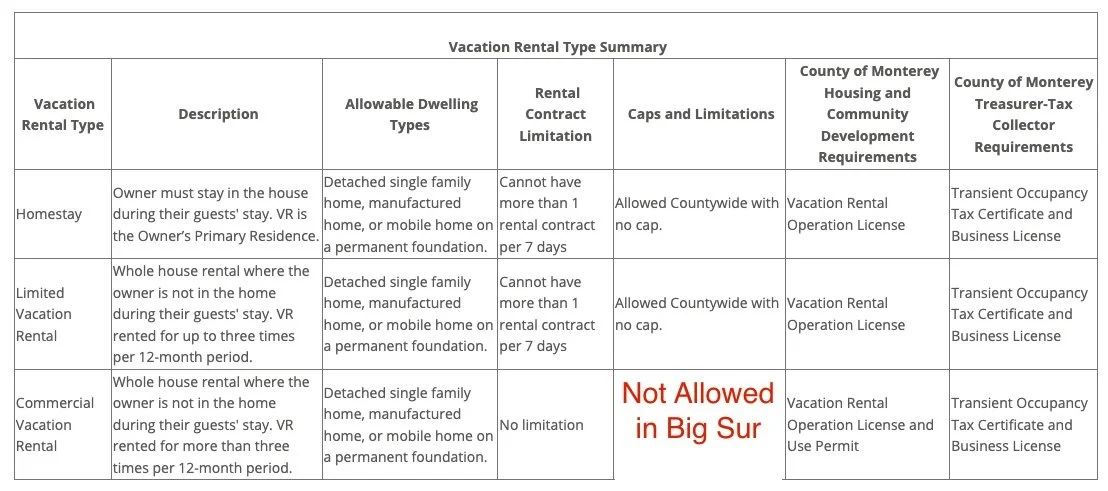
However, the court ruling did not eliminate the prohibition on commercial vacation rentals in Big Sur or expressly invalidate the ordinance’s separate restrictions on guesthouses and dwelling units.
Concerns About Enforcement
Keep Big Sur Wild is concerned about how the County is interpreting and enforcing the existing regulations.
The ordinance requires vacation rentals to operate within a qualifying single-family dwelling and prohibits guesthouses from being rented independently. Homestays also require a resident to occupy a bedroom within the vacation rental itself, not simply somewhere on the property.
An owner or resident living in one building while independently renting another should not automatically qualify as a lawful homestay.
Consistent enforcement of these existing requirements would resolve many of the problems surrounding vacation rentals in guesthouses and other secondary structures.
This is especially important in Big Sur, where housing for residents and local workers is already extremely limited.
Guesthouses, accessory dwelling units (ADUs), and junior accessory dwelling units (JADUs) provide valuable housing opportunities for people who live and work in our community. Allowing these structures to become short-term tourist accommodations removes potential long-term housing from an already limited supply.
These buildings should be providing homes for local residents and workers, not creating additional visitor accommodations.
The County’s October 28 staff report acknowledges enforcement difficulties, including the lack of a definition for applicants who must be “diligently pursuing” their permits. Yet other requirements concerning dwelling units, bedrooms, and guesthouses are specifically addressed in the ordinance.
Before changing the ordinance, the County should explain why it is not consistently enforcing the regulations already on the books.
What Do the Enforcement Numbers Show?
According to the County’s latest report, Big Sur has had six vacation rental enforcement cases and five administrative citations. Nearly $50,000 in fines are reported due, but only approximately $14,000 has been paid.
Countywide, 153 enforcement cases remain open, and the County reports that no vacation rental enforcement cases have proceeded to an administrative hearing.
These figures raise questions about the effectiveness of the current enforcement program.
Rather than weakening or restructuring the ordinance, the County should demonstrate that it can enforce the existing regulations and collect the penalties already assessed.
What Happens Next?
County staff has presented three potential approaches: make only legally required changes, amend the existing ordinance to address implementation problems, or consider an entirely different regulatory structure.
No ordinance amendments are scheduled for approval at the October 28 meeting. However, the Planning Commission may direct staff to pursue future changes.
Keep Big Sur Wild’s recommendation is straightforward: Leave the ordinance alone and enforce it.
The County spent years developing these regulations through an extensive public process. Many of the problems now being discussed could be addressed by consistently applying the existing definitions and requirements.
The County should preserve the prohibition on commercial vacation rentals in Big Sur, enforce restrictions on independently rented guesthouses and other ineligible secondary structures, and protect the limited housing opportunities available to local residents and workers.
Administrative difficulties should not become a justification for weakening the protections established through the County’s certified Local Coastal Program.
How to Participate
Monterey County Planning Commission
Wednesday, October 28, 2026, at 9:00 a.m.
Agenda Item 3 – REF260029, Vacation Rental Regulation Implementation Status Report
Written comments can be submitted to:
pchearingcomments@countyofmonterey.gov
Deadline: Tuesday, October 27, at 5:00 p.m.
The public may also participate in person or through Zoom.
We encourage Big Sur residents and others concerned about protecting our coast to review the proposed discussion and make their voices heard.
Big Sur needs homes for the people who live and work here, not more vacation rentals.

Short-Term Rental Ordinance Approved
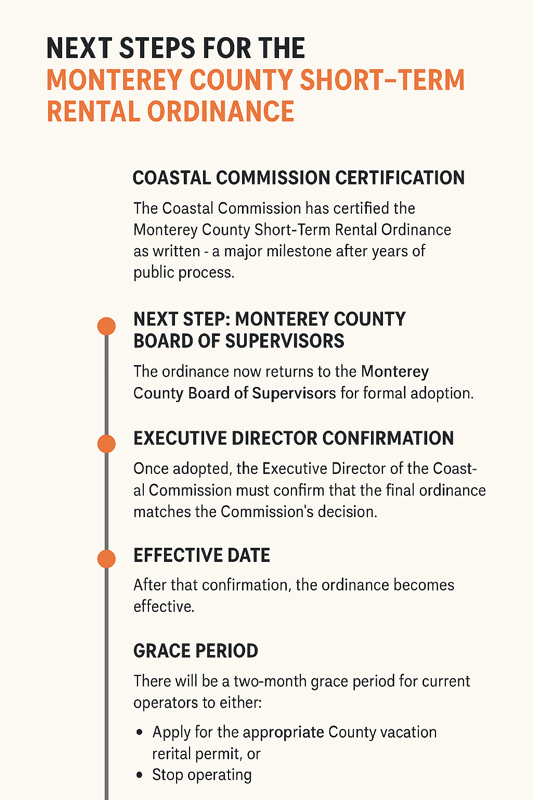
After years of community discussion, planning, and public input, the California Coastal Commission has officially approved the Monterey County Short-Term Rental Ordinance for the Big Sur Coast—exactly as written.
This is a major milestone. While the ordinance isn’t perfect, it establishes a solid foundation to protect housing for local residents, maintain the rural character of Big Sur, and ensure that tourism remains consistent with the Big Sur Land Use Plan. Importantly, it sets enforceable limits on vacation rentals and provides a framework that can be improved over time as we see how it works in practice.
A heartfelt thank-you to Monterey County staff, the Coastal Commission, and all community members who have worked tirelessly over the years to reach this point.